
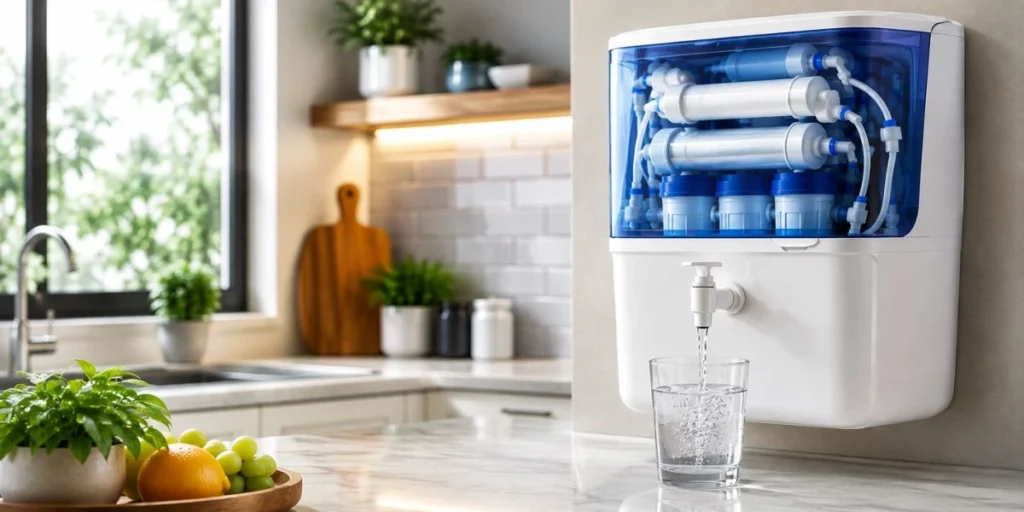
Quick question — when you last bought a UF water purifier, or even just researched one, did you actually understand what UF meant? Be honest. Most people don’t. RO gets all the attention because every ad screams about it. UV shows up too. But UF just kind of sits there on the box, unexplained, and everyone assumes it’s some minor add-on. It’s not. For a lot of homes, a UF water purifier is actually the better fit, and cheaper too. Let’s get into why.
Okay, So What Is a UF Water Purifier Exactly?
UF stands for Ultrafiltration, and a UF water purifier is built around exactly that — an ultrafiltration membrane doing all the heavy lifting. Strip away the technical jargon and it’s basically this: your water gets pushed through a membrane so fine it works like a super-tight net. We’re talking membrane pore sizes around 0.01 to 0.02 microns — a size so small it’s genuinely hard to picture. Those tiny pores trap bacteria, cysts, and other microorganisms, while letting actual water molecules pass through untouched.
Here’s the bit that surprised me when I first looked into it — a UF water purifier doesn’t strip out minerals the way an RO system does. RO membranes are so fine they filter out literally everything, good stuff included, which is why RO water sometimes tastes a bit flat or “empty.” A UF purifier skips that problem entirely. It only stops the bigger contaminants and leaves calcium, magnesium, and other essential minerals right where they belong — in your glass. That’s a big reason people searching for a mineral-retaining water purifier or a natural taste water purifier end up landing on UF technology.
How Does a UF Water Purifier Actually Work?
This is the part I genuinely appreciate about UF water purifiers — there’s nothing complicated happening.
Normal tap water pressure does all the work. No motor kicking in, no pump humming away, none of that. Inside most UF water purifiers, you’ll find a bundle of hollow fiber membranes — picture a handful of very thin drinking straws bunched together. Water flows into these hollow fibers, and as it pushes through the fiber walls, the ultrafiltration membrane catches whatever’s too big to pass. Clean, filtered water keeps moving forward. Simple as that.
That’s also why a UF water purifier is often described as a non-electric water purifier — no moving parts to break down, no power switch to worry about, no dependency on your area’s power supply. It just sits there quietly doing its job every time you turn on the tap, powered purely by household water pressure.
What Does a UF Water Purifier Remove — And What Slips Through?
This is honestly where most confusion happens, so let’s just lay it out plainly.
A UF water purifier is solid at removing:
- Bacteria and most waterborne viruses
- Cysts and parasites
- Sediment, turbidity, and suspended particles
- Algae and larger organic matter
- General cloudiness in drinking water
What it won’t touch, though:
- Dissolved salts (this is why TDS level matters so much when choosing between UF and RO)
- Heavy metals — lead, arsenic, that sort of thing
- Fluoride
- Nitrates
- Chlorine taste or smell (unless there’s an activated carbon filter added alongside it)
So think of a UF water purifier as being really good at tackling the biological and physical contamination in your water — essentially a strong line of defense against waterborne diseases. But chemical impurities dissolved into the water itself? That’s not its department. That’s where reverse osmosis steps in.
UF vs RO vs UV Water Purifier — Quick Comparison
| What matters | UF Water Purifier | RO Water Purifier | UV Water Purifier |
|---|---|---|---|
| Kills bacteria & viruses | Yes | Yes | Yes |
| Removes dissolved salts/heavy metals | No | Yes | No |
| Keeps natural minerals | Yes | Not unless remineralized | Yes |
| Needs electricity | No | Yes | Yes |
| Water wastage | None | Significant | None |
| Best suited for | Low-TDS municipal water | High-TDS or borewell water | Already-clear, low-turbidity water |
| Maintenance | Low | Higher | Low to moderate |
If I had to explain this water purification technology comparison to a friend in one breath — an RO water purifier is the heavy-duty option that deals with everything dissolved in water, a UV water purifier is more like a disinfectant that only works well on water that’s already fairly clean, and a UF water purifier sits comfortably in between, catching physical and biological contaminants without disturbing the water’s natural mineral balance.
Why People End Up Preferring a UF Water Purifier
No electricity involved, so no added cost to your power bill, and it keeps working even during a power cut — genuinely useful if you live somewhere with an unreliable power supply. This is exactly why so many people search for the best non-electric water purifier for home and land on UF technology.
It doesn’t waste water either, which honestly surprised me the first time I compared it to RO. Reverse osmosis systems reject a shocking amount of input water during purification. A UF water purifier just doesn’t do that — whatever goes in comes out as usable, purified drinking water, making it one of the more eco-friendly water purifier options on the market.
The taste stays natural too, since essential minerals aren’t stripped away. You’ll notice this if you’ve ever compared RO water and UF water side by side — RO tends to taste a little flat, UF doesn’t.
Maintenance-wise, it’s low-key. Mostly just periodic backflushing rather than swapping out expensive membrane cartridges every few months. And most compact water purifiers built on UF technology are small enough to tuck under a sink without needing a bulky storage tank setup.
Add it all up — no power cost, no wasted water, fewer filter replacements — and a UF water purifier ends up being noticeably cheaper to run over the years, which is why it’s often recommended as the best budget water purifier for treated water sources.
Where a UF Water Purifier Falls Short
If your water’s coming from a borewell, or it carries a high TDS reading, a UF water purifier just isn’t built for that fight. It won’t bring dissolved salt levels down — full stop. This is the single biggest reason people move on to an RO+UF combination purifier instead.
Cloudy or sediment-heavy water can also clog the ultrafiltration membrane faster than it should, unless a pre-filter is doing the heavy lifting first.
And obviously — dissolved chemical contaminants like heavy metals, fluoride, and nitrates — none of that gets caught by a UF membrane. It was never designed for that job.
There’s also a small, mostly theoretical risk that a few extremely tiny viral particles could slip through. It’s rare, but it’s the reason some people pair a UF purifier with a UV disinfection stage, just for extra reassurance — commonly sold as a UF+UV water purifier.
Should You Actually Buy a UF Water Purifier?
Ask yourself a couple of things. Is your water municipal or already treated, generally staying under 200–300 ppm TDS? Is bacterial contamination or general dirt more of a concern for you than dissolved salts or metals? Do power cuts happen often enough that you’d want a purifier that just works regardless? Does the idea of a zero-wastage water purifier appeal to you?
If most of that sounds like your situation, a UF water purifier is probably the right call, and one of the most practical water purifiers for home use on treated supply.
But if you’re on borewell water, or you already know your area struggles with high TDS or heavy metal contamination, UF by itself won’t cut it. You’d want reverse osmosis in the picture too — ideally a UF, RO, and UV combination purifier for complete protection.
Keeping Your UF Water Purifier Running Smoothly
It really doesn’t demand much, but a bit of regular maintenance helps it last.
Backflush the ultrafiltration membrane every so often — most UF water purifiers have a simple built-in setting for this. Keep tabs on the pre-filter and swap it when it’s due, particularly if your water source carries sediment. Notice the flow rate slowing down? That’s usually your cue to clean the membrane or replace a filter. Stick with whatever cleaning solution the manufacturer suggests — using a random one can actually damage the hollow fibers inside. And even when everything seems fine, get an annual service check anyway. Catching small issues early beats dealing with a bigger membrane replacement later.
Before You Buy a UF Water Purifier — A Quick Checklist
Test your water’s TDS level first. Genuinely, this one step tells you almost everything about whether UF alone will work for your home. Check the membrane’s pore size rating — finer pores usually mean better filtration efficiency. If your water source tends to be cloudy, look for a model that already includes a pre-filter stage. If biological safety matters more to you than mineral retention alone, a combined UF+UV water purifier might make more sense. Confirm replacement filters and servicing are actually available where you live — this gets overlooked way too often. And if you want purified water ready on demand instead of relying purely on tap pressure, check the storage tank capacity too.
Bottom Line
A UF water purifier isn’t flashy. It’s not the purifier getting the big ad campaigns. But for homes running on regular municipal or treated water, it’s honestly one of the more sensible water purification systems out there — no electricity cost, zero water wastage, minerals left intact, and barely any upkeep required. What it won’t do is handle high-TDS or heavy-metal-contaminated water, and that’s fine, because that was never its job to begin with.
So before deciding anything, just test your water first. Once you know what’s actually in it, figuring out whether a UF water purifier alone is enough — or whether it needs backup from an RO water purifier — becomes a much easier call.

Hi, My name is Abhishek Prajapatti I am a blogger and founder of rodelight.com. I have knowledge about about water purifier and I am sharing my experience.