
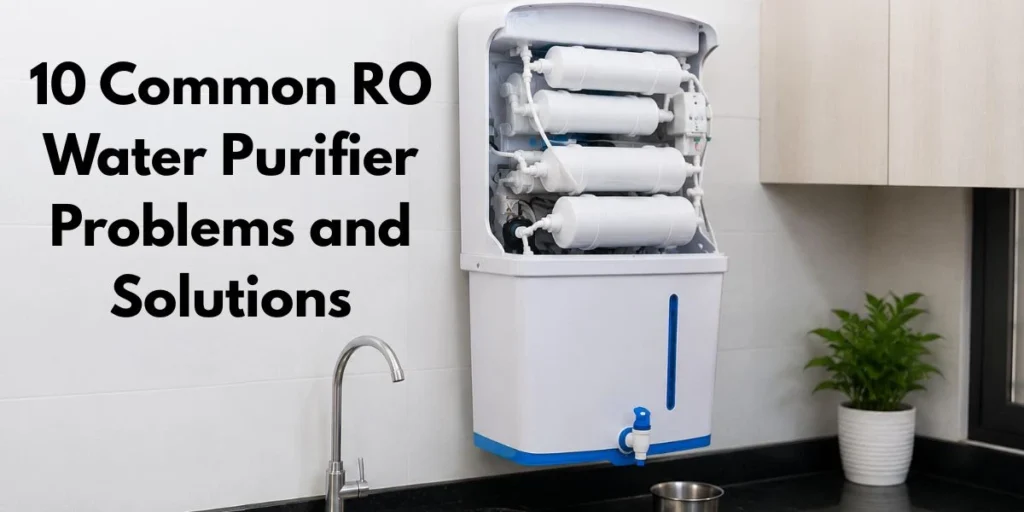
A water purifier is a necessary home appliance for all households, but it has some common issues when you are using it. First, you have to know about common RO water purifier problems.
An RO water purifier protects you from the problem of drinking dirty water and gives you clean drinking water from which you can live a healthy life without taking medicine.
When a water purifier gets older than 6 months, its filters start getting spoiled, and you will face dirty water problems, smell in water, RO not working, etc.
This all signs telling you to change filters and clean and maintain the whole purifier. So in this blog, you will get all information about common RO water purifier problems, and it’s solution.
How does an RO Water Purifier Work
Water purifiers work on many stages that clean water properly, and their supportive components work very well his job.
To understand the full process of the purification system need to know about all the filtration parts of an RO water purifier.
Main Components of an RO Purification System
For the step-by-step purification process, Ro need some filters like:
- Pre filter
- Sediment filter
- Carbon filter
- Membrane
- UV, UF filter
- Alkaline cartridge
- Storage tank
They all work together to make water drinkable, reduce TDS, and remove all impurities.
Role of Filters and Membrane
All basic filtration parts make water clean easily. Filters remove all types of harmful bacteria and viruses and help the membrane function properly.
All filters make the membrane work easily and protect it from getting spoiled. The membrane plays the role of removing high TDS from water.
Why RO Systems Need Maintenance
Because all filters inside store all impurities of water and get spoiled; that is the reason for maintenance of an RO system.
If you want to drink water for a long time, then you will take Care of maintenance time; otherwise, the purifier’s water taste will tell you everything.
This was your question’s answer on how an RO water purification system works. I hope you will like this information and should be helpful.
Common RO Water Purifier Problems and its solution
| Common Problems | Possible Causes | Quick Solution |
|---|---|---|
| RO not dispensing water | Low pressure or clogged filter | Check pressure and replace filters |
| Slow pure water flow | Blockage of membrane | Replace membrane; it is best |
| Water leakage | Loose fittings | Tight connectors and fitting |
| Bad taste and smell | Expired carbon filter | Replace carbon filter |
| Continuous water wastage | Fault auto shut-off valve | Replace auto shut off valve |
| RO loud making noise | Pump issue | Change Pump or it head |
| Tank not filling | Low pressure of pump | Check pump |
| TDS high above 150 | Membrane problem | Replace membrane |
| RO not working | Power supply issue | Check SMPS adapter and switch |
| Frequent filter choking | Dirty water supply | Install pre filter set |
It was a list of some common problems that you can fix easily with solutions, so apply them and save money.
Purifier not dispensing water.
When water flow doesn’t reach the storage tank, then it is a water not coming problem. This is a common problem; it can be resolved easily.
Causes of it
- Low pressure of water
- Sediment filter blocked
- Faulty booster pump
- Inlet valve closed
- Full water storage tank
Solution
- Check the water supply from the tap and check the water input valve; if block then clean it.
- The sediment and carbon filter is most important to check because after every 6 months it gets spoiled.
- Water pressure check because Ro system needs 40 to 60 PSI to function properly.
- Check Booster pump functioning: if the pump is not vibrating, no humming sound, and delay in filling, then change the pump.
Slow water flow from RO
Usually, slow water problem create because of sediment and a clogged carbon filter, a clogged membrane filter, or low pressure. To fix it, check all of these.
Common causes
- Choked pre-filters
- Chocked membrane
- Poor pipe connection
- Low pressure of storage tank
Solutions
- Flush RO membrane to remove impurities, or replacing it is the best option.
- Replace filters
- Check pressure if required, then fill it.
Water leakage problem
First find the actual leakage area, then take a solution. Like pipe joint, tap, filters Lbow, faucet, tank, membrane housing.
If the fitting is loose, tap water leaks, housing chocked and loose pipes.
Solution
- Fix fitting leakage; change O-ring rubber.
- Tighten the tap if the leak is from there.
- Replace housing if choked.
- Push the pipe properly to fix pipe leakage.
Bad smell and taste problem
Smell is normal in a water purification system because every 6 to 12 months, filtration parts get spoiled, which becomes the reason for bad smell.
Cause of it
This cause is created by a clogged carbon filter, which is responsible for bad taste and smell.
Solution
Simply change the carbon filter and fix it. Carbon should be of good quality.
Continue water wastage
Water wastage is a process of the purification system, but if water is wasted too much, then you should take action.
- Check the float valve; it is responsible for auto cut
- Check the SV; if not working properly, then change it.
RO making sound
RO doesn’t make sound, but if it happens, then you should check the cause and fix it early. Mostly the pump make noice it booster pump make notice, then change it or repair it.
Tank takes time to fill.
For tank filling problems, check water pressure. If water pressure is perfect, then you should check the membrane filter.
High TDS level
TDS (total dissolved solids) level matters for health, so take care of Tds level if Tds level high of water, then you should change the membrane filter to fix it because it is used to reduce the TDS level.
A drinkable TDS level of water is 50 to 150ppm. 150 to 300 ppm is acceptable but not for a long time, and above 500, don’t use it to drink as per WHO guidelines. All information from WHO guidelines.
Source- https://www.who.int/docs/default-source/wash-documents/wash-chemicals/total-dissolved-solids-background-document.pdf
RO not working
This is one of the common RO water purifier problems: if the electrical power supply of the purifier, the SMPS adaptor, is not working, then change it and check the power supply.
Second reason: booster pump not working; then RO will not work, so change or repair it.
SV problem: if the SV is not working, then it should be cause of purification process is not working, so check it if not working.
Early filters choking
It totally depends on water quality; if your water is very dirty, then it can block all filters. If the water is safe, then use good quality filters.
So check row water quality before install an Ro water purification system.
These are 10 common RO water purifier problems. If you are facing any problem, then I have told you the solution in this blog; follow it and do it for yourself.
Diy maintainence tips
I am telling you some maintenance tips for your water purification system’s health. You can follow them and be safe from expensive service and maintenance costs if you don’t want to face common RO water purifier problems.
Monthly maintenance tips
Here are some tips for you that can help you to manage your water purifier on a monthly basis.
- Clean the outer body with water or a cleaner that in insure dust is removed.
- Check the pipe fitting of the water purifier’s inner side.
- Check for leakage of the RO system because it common Ro water purifier problems in one of problem.
6 months tips
- After every 6 months, filter replacement is important; then replace sediment and carbon filters.
- Sanitize every part that is available in the water purification system.
Yearly maintenance tips
- Full service of the water purifier is important after 1 year.
- Membrane replace if not working properly; it is important because membrane life 1 year.
- Check the TDS level of water and maintain it by adjusting the TDS controller.
- Check that the pump works properly and has no issues, then change it.
These were some tips to maintain a water purification system. Follow these and keep away from common RO water purifier problems.
Replacement and repair are beneficial.
Some problems can be fixed after repair, but some common RO water purifier problems cannot be fixed with repair. In this condition, replacement is more important then replace part.
Next, see some situations of common RO water purifier problems and get suggestions on which is best.
| Situation | Repair | Replacement |
|---|---|---|
| Minor leakage | Yes | No |
| Old membrane | Yes | No |
| Repeated PCB failure | No | Yes |
| Tank damage | Yes | No |
| Purifier older than 7 years | No | Yes |
If you feel the repair cost is expensive and charge 50% amount of new part, then replacement is the best option.
When you should call professional technician?
When you face multiple common RO water purifier problems in RO, then you should take action and call a professional technician and take advice from him. If parts are damaged or repairable, then replace parts at a reliable price.
Check technician changes genuine parts.
Conclusion
I hope this blog will help you to keep your water purifier safe. In this, I told you about common RO water purifier problems that you face.
Follow the solutions that I suggested and do it yourself without any professional help. If you think you can’t do then call a technician.
FAQs
Why is water not coming from the filter?
This problem happens due to low-pressure water, a faulty booster pump, or clogged filters of the purifier.
How often do I need to change my RO filters?
When you feel bad taste and smell in water, then filter replacement need or every 6 to 12 months. If Tds high of water then membrane should also be changed.
Why is my RO water tasting bitter?
This problem can be from a damaged membrane, high TDS, a dirty storage tank, and expired filters.
Is RO water purifier water wastage normal?
Yes, it is normal because dirty water is waste for the filter. Pure water will be stored in the tank.
How long is an RO membrane life?
Usually, a membrane filter life of 1 to 2 years, but it depends on water quality.
What is the ideal TDS level of drinking water?
As per WHO guidelines, an ideal TDS level is 50 to 150ppm.
Can low-pressure water damage an RO water filter?
Yes, it can damage the membrane because low pressure impacts its work and can damage.

Hi, My name is Abhishek Prajapatti I am a blogger and founder of rodelight.com. I have knowledge about about water purifier and I am sharing my experience.