
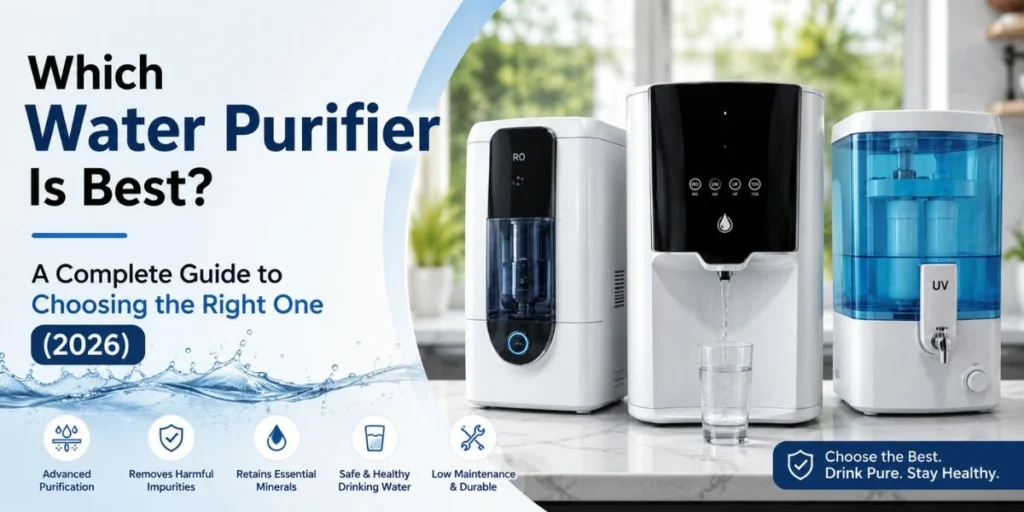
Standing in a store, staring at ten different water purifiers with similar-sounding names and confusing spec sheets, is one of the most common shopping frustrations Indian households face today. Every brand claims to be the “best,” every box is covered in acronyms like RO, UV, UF, and TDS, and the salesperson usually pushes whatever model earns the highest margin. So how do you actually figure out which water purifier is best for your home?
The honest answer is: there’s no single “best” purifier for everyone. The right choice depends on your water source, your area’s TDS level, your family size, and your budget. This guide walks you through exactly how to make that decision, without the sales pitch.
How to Know Which Water Purifier Type You Actually Need
Before comparing brands or models, you need to understand your own water first. Skipping this step is the single biggest reason people end up with the wrong purifier.
Step 1: Test Your Water’s TDS Level
TDS, or Total Dissolved Solids, tells you how much salt, mineral, and dissolved impurity content your water carries. A simple handheld TDS meter, available for a few hundred rupees online, gives you this reading in seconds. This one number decides almost everything about which purifier technology you should choose.
Step 2: Identify Your Water Source
Water quality varies drastically depending on where it comes from:
- Municipal supply in cities usually carries a moderate TDS level and is treated to some extent before it reaches your tap.
- Borewell or groundwater tends to carry a much higher TDS level, along with dissolved salts and sometimes heavy metals, depending on your region.
Knowing your source narrows your options considerably before you even walk into a store.
Step 3: Match TDS Range to Purifier Type
Once you know your TDS reading, the decision becomes far simpler:
| TDS Level | Recommended Purifier |
|---|---|
| Below 200 ppm | UV or UF purifier is usually enough |
| 200–300 ppm | UV+UF works, RO is optional |
| Above 300 ppm | RO purifier is necessary |
Keep in mind that TDS alone doesn’t guarantee safety — water can show a low TDS reading and still carry issues like excess fluoride or trace heavy metals that a TDS meter won’t detect. If you’re uncertain, a basic water quality lab test or your local municipal water report can fill in the gaps.
RO vs UV vs UF Water Purifier — Which One Wins?
Each purification technology solves a different problem. Understanding what each one actually does will save you from paying for features you don’t need — or worse, missing protection you do need.
What Is RO (Reverse Osmosis) and When You Need It
RO purifiers push water through a extremely fine membrane that blocks dissolved salts, heavy metals, and pesticides — contaminants that UV light simply cannot remove. If your water source has a high TDS reading, especially borewell water, RO isn’t optional; it’s the only reliable way to bring your water down to a safe and pleasant-tasting level.
What Is UV Purification and Its Limitations
UV purifiers use ultraviolet light to kill bacteria and viruses in the water. They’re effective against biological contamination but do nothing to reduce dissolved salts or heavy metals. This makes UV purifiers a good fit for municipal water with low TDS, but a poor choice on their own for borewell water.
What Is UF and How It Differs from RO
UF, or Ultrafiltration, works like a very fine physical sieve. It removes larger particles, some bacteria, and sediment, but unlike RO, it cannot filter out dissolved salts. UF is often paired with UV or used as a pre-filtration stage rather than as a standalone solution for hard water.
Combination Purifiers (RO+UV+UF) — Best of All Worlds?
Most modern purifiers on the market now combine all three technologies. RO handles dissolved solids, UV handles biological contamination, and UF adds an extra physical filtration layer. For most households — especially where water quality fluctuates seasonally — a combination purifier offers the most complete protection and is generally the safer default recommendation.
Which Water Purifier Is Best for Different Situations
There’s no universal winner here — the best purifier changes depending on your specific circumstances.
Best for Borewell or High-TDS Water
If your TDS reading crosses 300 ppm, prioritize a purifier with a strong RO stage, ideally paired with a TDS controller that lets you adjust mineral retention manually. Combination RO+UV+UF models with mineral or alkaline enhancement tend to perform best here, since they compensate for the minerals RO naturally strips away.
Best for Municipal or Low-TDS Water
If you’re on treated municipal supply with TDS consistently under 200–300 ppm, a UV+UF purifier is often sufficient and comes with the added benefit of avoiding unnecessary RO water wastage. This is also the more budget-friendly and lower-maintenance route.
Best for Areas with Frequent Power Cuts
RO and UV purifiers both need electricity to function. If your area experiences frequent outages, a non-electric gravity-based purifier with multiple filtration cartridges is worth considering as either a primary or backup option.
Best for Large Families
Tank capacity matters more than most buyers realize. A family of four to five typically needs at least 7–8 litres of storage, while larger households should look at 10-litre-plus tanks to avoid running out of purified water during peak usage hours.
Best Low-Wastage, Water-Saving RO Models
Traditional RO systems can waste three to four litres of water for every litre purified. Several newer models now use smarter membrane technology and water-saving modes that significantly cut this wastage, sometimes by close to half, while still delivering the same purification quality. If sustainability and your water bill matter to you, actively look for a purifier that advertises its recovery rate or water-saving percentage.
Top Water Purifier Categories to Consider in 2026
Rather than chasing one “best overall” model, it helps to think in categories based on what you actually need:
Best Overall Pick: Look for a combination RO+UV+UF purifier with mineral retention, a TDS controller, and a proven service network in your city. These tend to balance purification quality, running cost, and after-sales reliability.
Best Budget Pick: Entry-level RO+UV+UF models in the ₹7,000–₹10,000 range typically cover the essentials well for small families on moderate-TDS water.
Best for Borewell Water: Purifiers with a dedicated TDS controller and mineral or alkaline cartridge handle high-salinity groundwater more comfortably and protect the taste of the output water.
Best Premium Pick: Models that dispense both hot and ambient purified water add convenience for daily use, though they come at a noticeably higher price point and sometimes patchier regional service.
Best Water-Saving Pick: If reducing RO wastage is a priority, choose a model explicitly marketed with a high recovery rate or water-saving certification.
Water Purifier Buying Checklist — What to Check Before You Buy
Before finalizing any purifier, run through this checklist:
- Purification stages and technology — match it to your TDS reading, not marketing claims
- Tank storage capacity — size it to your family, not the smallest available option
- Water wastage or recovery rate — ask specifically, since it’s rarely printed on the box
- After-sales service availability — a purifier is only as good as the technician who can service it in your city
- Warranty and running cost — factor in membrane and filter replacement costs, not just the upfront price
- Mineral retention — check whether the model adds back essential minerals after RO filtration, since RO alone strips them out
Common Mistakes People Make While Choosing a Purifier
- Buying RO without checking TDS first — if your TDS is already low, RO wastes water and strips minerals unnecessarily.
- Ignoring the service network — a purifier with poor local service support becomes a headache within the first year.
- Choosing tank size based on price instead of family size — leads to constant refilling and frustration.
- Overlooking the real wastage rate — some models waste far more water than advertised once installed.
Frequently Asked Questions
Which water purifier is best for home use in India? It depends on your water’s TDS level and source. For borewell water above 300 ppm, an RO-based combination purifier is best. For municipal water under 200–300 ppm, a UV+UF purifier is usually sufficient.
Is RO or UV purifier better for daily use? Neither is universally “better” — RO removes dissolved salts and heavy metals, while UV kills bacteria and viruses. Most households benefit most from a combination of both.
How do I know if I need an RO purifier? Test your water with a TDS meter. If the reading crosses 300 ppm, or your water comes from a borewell, an RO purifier is generally necessary.
Which brand offers the best after-sales service? Service quality varies by city, but established brands with a wide technician network tend to offer more consistent support than newer or lesser-known brands.
Is a higher number of purification stages always better? Not necessarily. What matters more is whether the stages match your actual water quality needs — extra stages on already-clean water add cost without meaningful benefit.
Conclusion
The question “which water purifier is best” doesn’t have a one-size-fits-all answer — but it does have a clear decision path. Start by testing your water’s TDS level, identify whether your source is municipal or borewell, factor in your family size and budget, and then match those answers to the right purification technology. Do that, and you’ll end up with a purifier that actually fits your home instead of one that simply looked good on a store shelf.
Before you buy your next purifier, take five minutes to test your water’s TDS — it’s the single most useful step in this entire decision.

Hi, My name is Abhishek Prajapatti I am a blogger and founder of rodelight.com. I have knowledge about about water purifier and I am sharing my experience.