
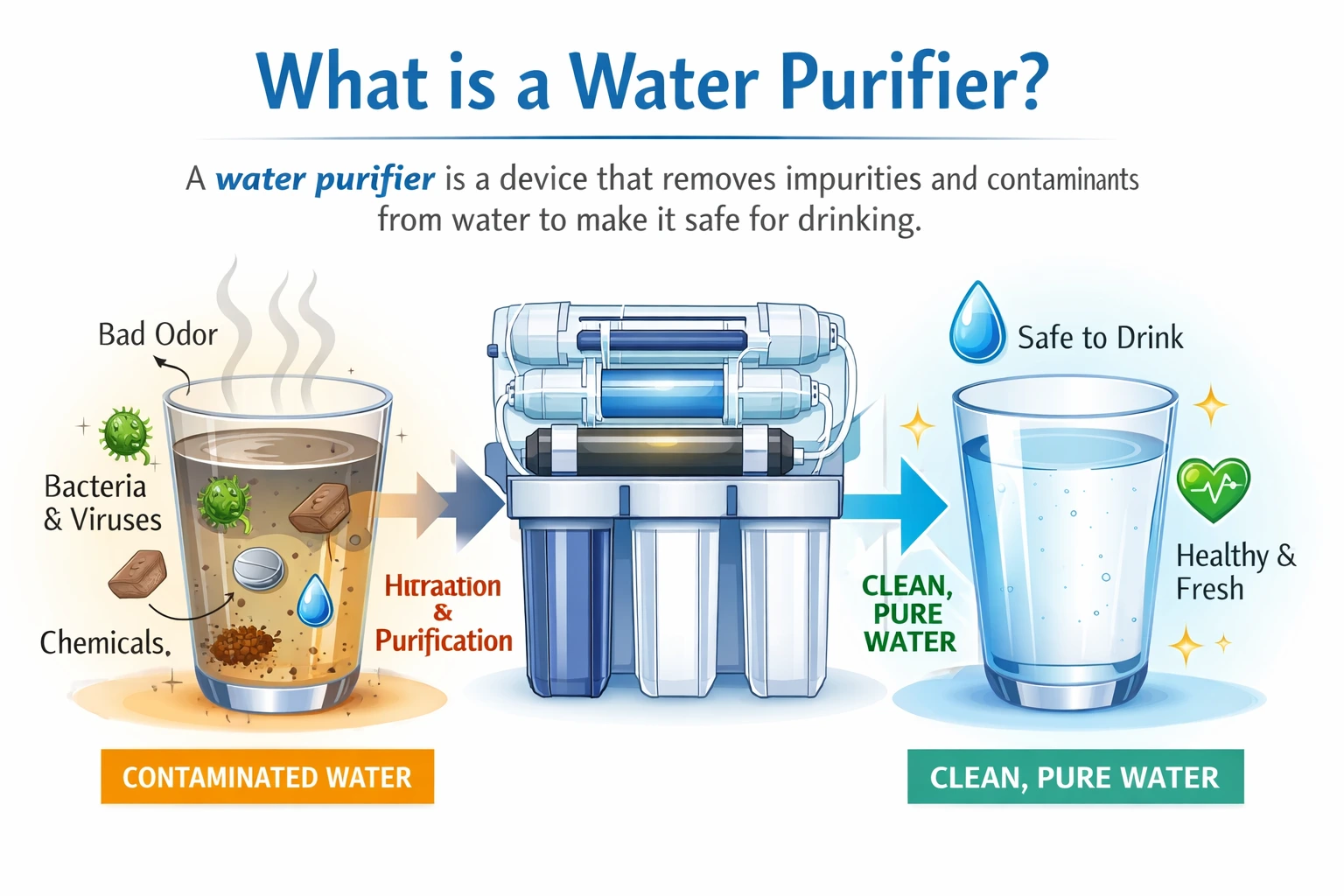
Before choosing any water purification system, one basic question often comes to mind: what is a water purifier, and why has it become so important today? We use water every single day—for drinking, cooking, and even preparing food—yet very few people actually know what is mixed into the water they consume regularly. Clear water does not always mean clean water.
Due to pollution, industrial discharge, old pipelines, and contaminated groundwater, drinking water can contain harmful bacteria, viruses, heavy metals, and chemical impurities. These contaminants are usually invisible but can slowly affect digestion, immunity, and overall health. This growing risk is the main reason why water purification is no longer optional for modern households.
If you want to buy a water purifier for home use which make healthy water for your family. Then you have to know what is a water purifier? and what’s the process of water purification so in this blog you will get know all about what is a water purifier?
Why Water Purification Matters Today
Clean drinking water is no longer something we can take for granted. With increasing pollution, industrial waste, aging pipelines, and groundwater contamination, the quality of water reaching our homes has changed significantly. Even if water looks clear, it may still contain harmful bacteria, viruses, heavy metals, or dissolved chemicals that are invisible to the naked eye.
This is where water purification becomes extremely important. A proper water purification system ensures that the water you drink every day is safe, healthy, and suitable for long-term consumption. In this article, we will clearly explain what is a water purifier?, how it works, its types, benefits, and why almost every household today needs one. The goal is to help you make an informed and confident decision for your family’s health.
What Is a Water Purifier and Why Do We Need It?
So, what is a water purifier in simple words? A water purifier is a device designed to remove impurities, contaminants, and microorganisms from water to make it safe for drinking and cooking. Unlike basic filters, a water purifier focuses on improving overall water quality, not just taste or clarity.
We need water purifiers because modern water sources are exposed to many risks. Tap water may contain chlorine, rust, bacteria, or dissolved salts. Borewell or groundwater can have high TDS (Total Dissolved Solids), fluoride, arsenic, or other harmful substances. Even packaged water is not always reliable.
A water purifier acts as a protective layer between unsafe water and your body. It helps reduce health risks, supports better digestion, and ensures peace of mind. For families with children, elderly members, or people with weak immunity, a water purifier is not a luxury—it is a necessity.
My feedback
“My experience of water purifier when I got know what is a water purifier? After that I feel this technology can clean my water. Now I am enjoying this technology and drinking healthy water.”
What Does a Water Purifier Do?
Many people ask, what does a water purifier do exactly? The answer is simple but powerful. A water purifier performs multiple important functions to improve water quality.
Here’s what a water purifier does in daily use:
- Removes harmful bacteria and viruses that cause waterborne diseases
- Reduces dissolved salts and chemical contaminants
- Eliminates unpleasant taste, smell, and color from water
- Filters out heavy metals like lead, mercury, and arsenic
- Improves overall safety of water for drinking and cooking
As a result, the water becomes healthier, fresher, and safer for regular consumption. Over time, this directly contributes to better health and fewer illnesses caused by contaminated water.
What Does Water Purifiers Differently from Water Filters?
Although the terms are often used interchangeably, water purifiers and water filters are not the same. Understanding this difference is important before making a buying decision.
Water filters usually remove visible impurities such as dust, sand, or rust. They also improve taste by reducing chlorine. However, they may not remove microorganisms or dissolved chemicals.
On the other hand, water purifiers are designed to handle complex contamination. They use advanced technologies to eliminate bacteria, viruses, and dissolved solids. In areas where water quality is uncertain or poor, a purifier offers far more reliable protection.
In short, water filters offer basic cleaning, while water purifiers provide complete purification.
What Are Two Types of Water Purifiers?
There are several types of water purifiers available, but the two most commonly used ones are RO and UV water purifiers. Each type serves a different purpose depending on water quality.
RO (Reverse Osmosis) Water Purifier
An RO water purifier uses a semi-permeable membrane to remove dissolved salts, heavy metals, and chemical impurities. Water is pushed through this membrane, leaving contaminants behind.
RO purifiers are ideal for:
- High TDS water
- Borewell or tanker water
- Areas with chemical contamination
They provide thorough purification and significantly improve water quality.
UV (Ultraviolet) Water Purifier
A UV water purifier uses ultraviolet light to kill bacteria and viruses present in water. It does not remove dissolved salts but is effective against microorganisms.
UV purifiers are suitable for:
- Low TDS water
- Municipal or treated water supply
- Areas where biological contamination is the main concern
Many modern systems also combine RO and UV technologies for better results.
Water Purifier Working Process Explained Simply
Understanding the water purifier working process helps build trust in the system you use every day. While the exact process depends on the purifier type, most follow a multi-stage purification method.
Here is a simple explanation of how a water purifier works:
- Sediment Filtration
The first stage removes dust, sand, rust, and other visible particles. - Carbon Filtration
Activated carbon filters remove chlorine, bad odor, and organic impurities. - RO Membrane (if available)
This stage removes dissolved salts, heavy metals, and chemical contaminants. - UV Purification (if available)
UV light kills bacteria, viruses, and microorganisms. - Mineral Enhancement (optional)
Some purifiers add essential minerals back into the water to improve taste.
After these stages, the water is clean, safe, and ready for consumption.
Read more- How does water purifier work?
Advantages of Water Purification for Daily Life
The advantages of water purification go beyond just clean water. A good purifier positively impacts your health, lifestyle, and expenses.
Here are the key benefits:
- Protects against waterborne diseases like diarrhea and typhoid
- Improves digestion and overall immunity
- Provides better-tasting and odor-free water
- Safe for children, elderly people, and pregnant women
- Reduces dependence on bottled water
- Cost-effective in the long run
- Environment-friendly by reducing plastic waste
When you drink purified water daily, you are investing in long-term health and well-being.
How to Choose the Right Water Purifier for Your Home
Choosing the right water purifier depends on your water source and quality. There is no one-size-fits-all solution.
Before buying, consider these factors:
- Test your water TDS level
- Identify your water source (tap, borewell, tanker)
- Decide between RO, UV, or RO+UV based on contamination
- Check storage capacity and electricity usage
- Ensure availability of service and maintenance
Making the right choice ensures effective purification and hassle-free use.
Common Myths About Water Purifiers
Despite their benefits, many myths still exist around water purifiers.
- “Boiling water is enough”
Boiling kills bacteria but does not remove chemicals or heavy metals. - “RO removes all minerals”
Modern RO systems balance purification with mineral retention. - “Water purifiers are expensive”
Compared to medical bills and bottled water, purifiers are cost-effective.
Understanding facts helps you make smarter decisions.
Conclusion: what is a Water Purifier Worth It?
Now that you clearly understand what is a water purifier, its working process, types, and advantages, the answer becomes obvious. A water purifier is one of the most important appliances for a healthy home. It protects your family from hidden dangers present in everyday water and ensures safe hydration.
In a world where water quality cannot be trusted blindly, a reliable water purifier offers safety, convenience, and peace of mind. Choosing the right purifier today means choosing better health for years to come.
7 thoughts on “What is a Water Purifier?”