
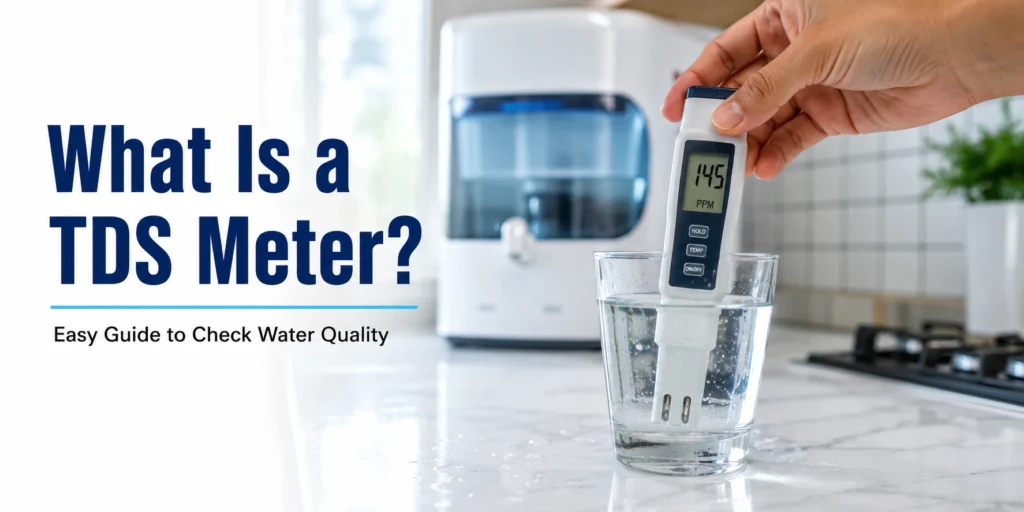
Everyone needs clean water for a healthy life. People purchase a water purifier to improve the quality of the drinking water, but only a few people know how to check whether a water purifier is working properly. This is where a TDS meter becomes useful.
Tds meter is a small digital device that helps you to measure the amount of dissolved solids in water. Simple to use you can easily use it, affordable price and it provides results within a second. Any type water you can use borewell, MCD and Ro water, a Tds meter can easily monitor your water quality.
In this blog, you’ll read what is a TDS meter, how Tds meter works, how to use it correctly, what the readings mean, and why every homeowner should understand TDS.
What Is TDS?
TDS stands for Total Dissolved Solids. It refers to the total amount of dissolved minerals, salts, and other substances present in water.
These dissolved solids are usually invisible to the naked eye because they are completely mixed with the water.
Common dissolved substances include:
- Calcium
- Magnesium
- Sodium
- Potassium
- Chlorides
- Sulfates
- Bicarbonates
Some of these minerals are naturally present in water and can even be beneficial in moderate amounts. However, excessively high TDS levels may affect the taste of water and indicate the need for additional testing.
What Is a TDS Meter?
A TDS meter is a handheld electronic device that estimates the amount of dissolved solids in water. It displays the result in PPM (Parts Per Million).
Instead of identifying each mineral, the meter provides an overall estimate of dissolved substances.
Because it is portable, quick, and easy to operate, it is commonly used by:
- Homeowners
- RO water purifier users
- Water treatment technicians
- Aquarium owners
- Laboratories
- Schools
- Small businesses
How Does a TDS Meter Work?
A TDS meter works by measuring the electrical conductivity of water.
Pure water does not conduct electricity very well. When minerals and salts dissolve in water, they allow electricity to pass through more easily.
The meter measures this conductivity and converts it into a TDS value shown on the display.
The process usually takes less than ten seconds.
What Does a TDS Meter Measure?
A TDS meter measures the total dissolved solids concentration in water.
It helps indicate:
- Mineral concentration
- Salt concentration
- Overall dissolved solids
- Changes in water quality over time
However, it does not identify individual contaminants.
What a TDS Meter Cannot Measure
One of the biggest misunderstandings is believing that a TDS meter can determine whether water is completely safe to drink.
It cannot detect:
- Bacteria
- Viruses
- Microplastics
- Pesticides
- Individual heavy metals
- Harmful chemicals
- Water odor
- Water color
For complete water quality analysis, laboratory testing or specialized equipment may be required.
Why Should You Use a TDS Meter?
A TDS meter offers several practical benefits.
1. Monitor Your RO Water Purifier
It helps you check whether your purifier is reducing dissolved solids as expected.
2. Compare Different Water Sources
You can compare:
- Tap water
- Borewell water
- RO water
- Bottled water
- Filtered water
3. Detect Changes in Water Quality
A sudden increase or decrease in TDS may indicate that your water source or filtration system has changed.
4. Save Money
Regular testing may help you notice changes in filter performance before they become major issues.
5. Quick Results
Most digital TDS meters display readings within a few seconds.
How to Use a TDS Meter
Using a TDS meter is very easy.
Step 1
Fill a clean glass or container with water.
Step 2
Remove the protective cap from the meter.
Step 3
Turn on the device.
Step 4
Dip only the probe into the water.
Step 5
Wait until the reading becomes stable.
Step 6
Read the result shown on the display.
Step 7
Remove the meter, rinse the probe with clean water, and replace the cap.
Understanding TDS Meter Readings
The reading is displayed in PPM (Parts Per Million).
Here is a general guide.
| TDS (PPM) | General Understanding |
|---|---|
| Below 50 | Very low dissolved minerals |
| 50–150 | Low mineral content |
| 150–300 | Moderate mineral content |
| 300–500 | Higher mineral content |
| Above 500 | High dissolved solids; further evaluation may be helpful |
Remember, TDS is only one indicator of water quality. A low or high reading alone does not determine whether water is safe to drink.
Is Low TDS Always Better?
Not necessarily.
Many people assume that the lower the TDS, the healthier the water.
This is not always true.
Water naturally contains minerals that contribute to taste and overall composition. Extremely low TDS water may taste flat because many dissolved minerals have been removed.
The ideal TDS level depends on the water source, treatment method, and local water conditions.
Who Should Buy a TDS Meter?
A TDS meter is useful for many people.
It is especially recommended for:
- RO purifier owners
- Families using borewell water
- Apartment residents
- Homeowners
- Travelers
- Aquarium hobbyists
- Small offices
- Cafes and restaurants
Common Uses of a TDS Meter
People use a TDS meter for different purposes.
Some common examples include:
- Checking drinking water
- Monitoring RO purifier performance
- Comparing tap water and filtered water
- Testing borewell water
- Measuring aquarium water
- Educational science experiments
Tips for Accurate Readings
To get reliable results:
- Use a clean container.
- Test fresh water.
- Keep the probe clean.
- Do not touch the metal sensor.
- Wait until the reading stabilizes.
- Store the meter in a dry place.
- Replace batteries when needed.
Common Mistakes to Avoid
Avoid these common mistakes.
Testing Dirty Containers
A dirty container may affect the reading.
Measuring Hot Water
Allow hot water to cool before testing.
Not Cleaning the Probe
Always rinse the probe after every use.
Reading Too Quickly
Wait a few seconds for the display to stabilize.
Assuming TDS Means Water Safety
A TDS meter does not detect germs or harmful microorganisms.
How to Maintain a TDS Meter
Proper maintenance helps improve accuracy and increase the life of the device.
- Clean the probe after every use.
- Keep the protective cap on.
- Avoid dropping the meter.
- Store it in a cool, dry place.
- Replace batteries when necessary.
- Follow the manufacturer’s calibration instructions if your model supports calibration.
Advantages of Using a TDS Meter
- Easy to use
- Instant results
- Portable
- Affordable
- Suitable for home use
- Helps monitor water purifier performance
- Requires very little maintenance
Limitations of a TDS Meter
Although useful, it has some limitations.
- Does not detect bacteria
- Does not identify individual minerals
- Cannot measure viruses
- Does not test for pesticides
- Cannot replace laboratory testing
- Reading alone does not confirm water safety
Understanding these limitations helps you use the device correctly.
Frequently Asked Questions
What does TDS stand for?
TDS stands for Total Dissolved Solids.
What unit does a TDS meter use?
Most meters display readings in PPM (Parts Per Million).
Can a TDS meter detect bacteria?
No. It cannot detect bacteria or viruses.
Can I use a TDS meter every day?
Yes. Daily testing is perfectly safe and may help you monitor changes in your water source.
Does boiling water reduce TDS?
Boiling kills many microorganisms but does not significantly reduce dissolved solids.
Is a TDS meter difficult to use?
No. Most people can learn to use one within a few minutes.
How long does a TDS meter last?
With proper care and battery replacement, a good-quality meter can last for several years.
Final Thoughts
A TDS meter is a simple yet valuable tool for anyone who wants to keep an eye on their drinking water. It provides a quick estimate of the dissolved solids in water and helps you monitor the performance of your water purifier over time.
While it cannot detect bacteria, viruses, or harmful chemicals, it is still one of the easiest ways to compare water sources and identify noticeable changes in water quality. When used correctly and combined with regular maintenance of your filtration system, a TDS meter can become an important part of maintaining clean, consistent drinking water at home.
Whether you’re using an RO purifier, relying on borewell water, or simply curious about your tap water, a TDS meter is a practical tool that makes understanding water quality much easier.

Hi, My name is Abhishek Prajapatti I am a blogger and founder of rodelight.com. I have knowledge about about water purifier and I am sharing my experience.